Most custom homes wouldn’t be complete without the 100-gallon whirlpool tub and the jetted shower system in the master bathroom, plus showers and tubs in other bathrooms, as well as large-capacity washing machines and dishwashers. All these systems and appliances can put a severe strain on the water heater, which requires a recovery period once it runs out of hot water.
Tankless water heaters have dominated European and Asian markets for decades. But when Asian and European models were brought to the U.S. nearly 20 years ago, they fizzled, despite expectations that they could provide a viable whole-house alternative to conventional tank water heaters.
Now newer models are beginning to prove their worth both as energy-saving appliances and as a source of continuous hot water for homes.
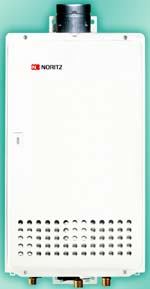
Tankless water heaters offer several advantages over conventional water heaters: energy efficiency, a constant supply of hot water, and space savings. The systems are relatively straightforward. Instead of continuously drawing on energy resources to heat, store, and reheat water in a tank, tankless systems flash-heat water as it is needed by passing it through a copper heat exchanger.
When a hot water tap is turned on, a flow sensor signals the burners to fire. “The sensor detects the temperature and flow rate of the incoming water and calculates exactly how many BTUs to fire in order to heat the water to the desired or set temperature,” says Tiffani Thompson, Rheem Water Heaters’ specialty products sales manager. “And it will modulate the BTU input to maintain maximum energy efficiency. When the tap is turned off, the entire unit shuts down, and there is no standing pilot. ”
There is no recovery period. “You can save 40 to 60 percent on the water heating portion of your gas bill,” says Brad Monaghan, East Coast sales manager for Takagi.
Sizing the unit appropriately to the home and its users’ needs is critical for optimal performance. Depending on the size of the home, the hot water requirements of its plumbing system and appliances, and owner usage habits, a home may require one or two tankless units. Some manufacturers claim that a single high-capacity unit can supply an entire home’s hot water needs, while others recommend zoning two units in larger homes. Because tankless systems are compact and are designed with sealed combustion, they can be surface- or flush-mounted in closets or on interior walls with proper venting, making zoning easier.
Builders can benefit from tankless systems, as well. “This is an opportunity to upsell to a more expensive appliance,” points out Kyle Murray, vice president of marketing for Controlled Energy Corp. “The other advantages from the builder’s standpoint are the space savings and the opportunity to offer an energy-efficient appliance to the consumer.”
Interest in tankless systems is high. In the past few years, tankless water heaters have seen a 20 percent to 30 percent increase per year, Murray says. Currently, they account for 2 percent of the overall residential water heater market, up from 1 percent last year, according to Richard Ponce, national sales manager for Noritz.
Some custom builders have leapt onto the tankless bandwagon, while others have taken a more leisurely approach. Mike Curlin of Curlin Custom Homes in Dallas installed a tankless system in his own home before he would even think about recommending them to his clients. “I wanted to try it because of the energy efficiency, and I wanted to be the guinea pig,” Curlin says. He now uses the systems in nearly 30 percent of the homes he builds.
Custom builder Craig Melstrand of Germantown, Wis.-based Majestic Homes says his firm started using tankless systems about one year ago, and since then Majestic has installed the systems in eight of its homes. “We’ve had a pretty good response,” Melstrand says. “We are one of the few builders in our area using these systems. The customer now is more knowledgeable, and they’re seeing these systems on TV, and the fact that we use it gets us a lot of inquiries.”
Identifying the ideal candidate for a tankless system can be difficult. Target clients range from those concerned with energy efficiency and utility savings to those who just want to fill that 100-gallon tub and still have hot water for their family and guests.