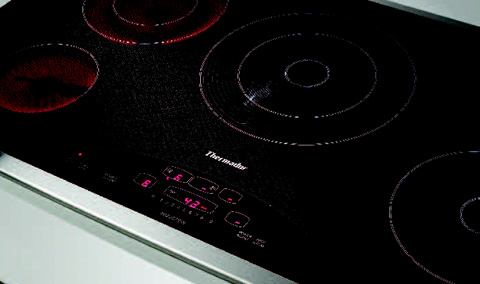
INDUCTION COOKTOPS—WHICH USE A magnetic field to generate heat—were introduced to the American market nearly 20 years ago. Popular in Europe, where natural gas is generally expensive, induction technology has been unsuccessful in this country because of its low power and unreliability.
But that was old induction. The technology has matured, manufacturers say, which is why several well-known companies have introduced a handful of new appliances to the market.
The renewed interest in induction can be linked to the current focus on energy efficiency—the technology may now be a viable alternative to gas and radiant electric. Today’s induction products are energy efficient, safe, powerful, and versatile, manufacturers say. When each cooking type’s energy use is compared, induction is about 90 percent energy efficient, while gas is about 50 percent efficient, and radiant electric about 60 percent efficient, says Sue Bailey, lead product manager at Greenwood, Miss.–based Viking Range.
Elements in an induction appliance produce a magnetic field that reacts with iron molecules in many kinds of cookware, exciting the molecules and producing heat directly in the pot or pan. The cookware becomes hot, and the element stays relatively cool to the touch. “The time to boil water on an induction top is 13 percent faster than on gas and 20 percent faster than on radiant electric,” says Lori Wood, Sears, Roebuck and Co.’s buyer for cooking appliances.
Most manufacturers are using more-powerful induction coils than those used two decades ago, resulting in better performance, more cooking zones, and smaller burner boxes. Because burner boxes require ventilation clearance to allow the coils to stay cool, many induction cooktops still cannot be installed over built-in ovens. However, manufacturers indicate that future induction developments will likely include freestanding and slide-in ranges.
Industry experts say that the residential market is more open to induction technology than it was the last time around, but cost is still an issue: Product prices range from $1,400 to $3,339. But manufacturers point out that the price of the technology has stayed the same, while the prices of electricity and gas fuel have increased. Induction may be a smart choice after all.
For more product information, visit ebuild, Hanley Wood’s interactive product catalog, at www.builderonline.com or www.ebuild.com.