IF THE KITCHEN IS THE HARDEST-working room in the house, the countertop is its most important surface. That’s because the counter endures all manner of abuse, so the material has to be able to withstand a beating with aplomb.
Granite and quartz surfacing take abuse well. Attractive, durable, and relatively low-maintenance, the two materials are highly desirable, but both are very expensive. Fortunately, you have options.
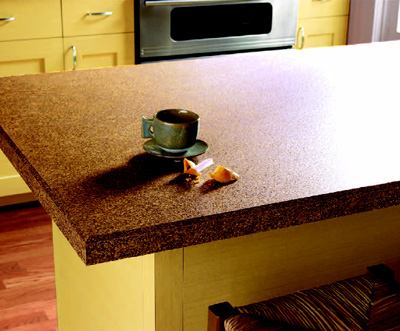
Michael Lander, president of The Lander Group, a Minneapolis-based developer, likes granite, and so do his buyers. But when he’s doing price-sensitive housing, he opts for trusty laminate. Laminate doesn’t receive much press coverage these days, but it’s still a good option for straightforward, reliable countertops.
“When we use laminate, we try to use a different thickness, with a different edge profile and custom backsplash to dress it up,” Lander says. “We’ve had people confuse laminate with more expensive materials.”
High-resolution printing technology has enabled laminate manufacturers such as Cincinnati-based Formica Corp. to develop products that replicate natural surfaces. “Our laminate collections offer endless design possibilities, including the new Riverwash finish, [which] mimics the aggregate stones found in concrete and the rusted elements of metals,” says Joe Thompson, Formica’s vice president of marketing and corporate branding. “In addition to its style and versatility, laminate is an ideal choice [because] it’s easy to install, easy to maintain, and is a cost-effective solution for many customers.”
Despite laminate’s versatility, it’s still not a “real” surface, and purists might balk at using it in their kitchens. Buyers who want to keep it real might consider wood, an old standby that’s undergoing a renaissance of sorts. Wood is warm and attractive, but it’s high-maintenance and doesn’t play well with water. Atlanta-based Craft-Art Wood Countertops believes this reputation is overblown, however. It’s all in the finish, the company says, and to prove it, Craft-Art fabricates its kitchen countertops with undermount sinks and now offers a line for the bath, as well.
“Consumer demand for custom wood pieces is continuing to grow, and our new custom vanity tops are a natural extension of our highly successful wood countertop product line,” says Ken Williamson, the company’s CEO. Available in more than 20 wood species, the tops come with a waterproof, stain-resistant, tung-oil—based penetrating varnish.
What if wood’s not your thing but you want a surface that will accept an undermount sink? Check out countertops made with concrete and recycled glass by IceStone, in Brooklyn, N.Y. IceStone’s surfaces are made with 100 percent recycled glass and concrete and contain no volatile organic compounds. Their composition is roughly 75 percent glass, 18 percent concrete, and 7 percent other proprietary ingredients, says Miranda Magagnini, co-CEO of the company. “The glass makes it more durable and resistant to stains,” she says.
If glass isn’t your bag, try paper. Paper-Stone from KlipTech Composites, in Hoquiam, Wash., is made from 100 percent post-consumer recycled paper. The company says it has “the strength of steel, beauty of stone, and warmth of wood, all with ease of workmanship.”
Whatever surface you choose ultimately will depend on your budget and your buyer. Keep in mind that every surface has its drawbacks. Still, you can make better purchasing decisions by remembering a few things. First, it’s a good idea to investigate surfaces before you design your kitchens. “Design to avoid waste,” Magagnini advises. “Before you design, think about slab sizes to get the best yields,” which saves money. Secondly, consider your target market and evaluate the pertinent pros and cons of certain materials, such as granite’s beauty versus its expense and stainless steel’s sleek look versus its tendency to show scratches. With all the counter choices available, there’s sure to be one that’s tops for you.
For more product information, visit ebuild, Hanley Wood’s interactive product catalog, at www.builderonline.com or www.ebuild.com.
Learn more about markets featured in this article: Atlanta, GA.