Home automation has traditionally branched into two main categories. The high end has been the domain of the rich, who can bankroll a team of electronics specialists to program and install a hardwired system managed by simple-to-use touchscreens. At the budget end, hobbyists have tinkered with X-10 modules to control lights and appliances via a rudimentary timer. Homeowners were either wowed by the luxury feel of a custom home automation system or fascinated by the tweaky nature of a do-it-yourself project. There was no middle ground.
The power of the Internet is changing that. Thanks to broadband connections that leave a data door always open in and out of the home, homeowners now have access to the electronic systems that control their homes whether they’re across the house or on the other side of the world. Webcams, for instance, have become an inexpensive way for hobbyists to rig up a remote monitoring system so that they can check on nannies or babysitters from the office.
Now Internet-based home control is moving from pieces and parts to a systems approach that average families can afford. An unlikely source, Shell Oil Co., is entering the home control market carrying a holistic approach to home control with a package of products that could take home automation to the masses. Shell brings a multinational presence to an industry that’s largely been served by low-profile brands.
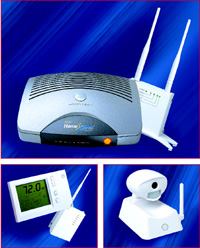
Called Shell HomeGenie, the system is based on a broadband connection to the Internet. That’s a fast-growing target. At the end of 2003, 21.5 million U.S. homes—about a fifth—connected to the Internet via broadband access, according to Jupiter Research. That number is expected to climb to 46 million by 2008. Shell’s message to homeowners is that modest control can be cheap, easy, and simple to install. And it doesn’t require new wiring—just a fast lane to the Internet. The $599 HomeGenie starter kit starts with a residential gateway made by Motorola. The gateway connects to a household modem, either from a DSL or cable provider. The kits are being sold through CompUSA, the retailer of computer and networking equipment, first in a controlled rollout in Texas, California, and Georgia, and then nationwide beginning in July.
If the house has a network, the Motorola gateway passes the broadband connection on to the network. HomeGenie doesn’t provide computer networking or file sharing. In fact, a PC is only required for setup. After that, homeowners set times for lights to go on or off, thermostat setback, and camera settings from the HomeGenie Web site using either a PC or a Web-enabled Palm, Pocket PC, or cell phone. All settings for controlling home devices are stored on servers at the HomeGenie head end. If there’s a power loss at the home, the appliances return to their scheduled settings when power is restored. A simple PC-based system wouldn’t be able to boot back up to the proper settings without homeowner intervention.
The HomeGenie starter system also includes one wireless power switch for a light or appliance, a wireless contact sensor for a door or window, and a wireless camera with a built-in motion sensor. If the motion sensor detects movement while, say, a homeowner is on vacation, a call is automatically placed to a designated cell phone. A family member can log on to the HomeGenie Web site, go to the house’s Web page and view the home live through the Web cameras to detect the source of the motion. In another example, a power switch could be used to start the spa from the office so that the water is at a perfect 102 degrees F by the time owners arrive home from work.
The modular system can be expanded to include seven cameras and 32 switches at $39 apiece, and additional contact and motion sensors can be added for $35 to $40 each. Wireless modules enable the system to install easily into existing homes, creating a no-new-wires whole-house control package that can be purchased for under $1,000. An optional $135 programmable thermostat requires professional installation. The rest of the sensors and switches can be installed by the homeowner by plugging them into the wall on one end and the appliance on the other. Programming is done via a menu-based interface on the Web site.
What’s in it for Shell? A recurring $25 per month service fee. Borrowing a business model from the security industry, Shell sells hardware built and branded by manufacturers including Motorola and Xanboo. The real revenues for Shell come from the $300 annual service fee. That includes 14-hour-per-day customer support, back-up storage of user settings on Sun Microsystems servers at the HomeGenie head end, 20 megabytes storage of recorded video from Web cameras in the home, a family calendar, and software updates.
Shell isn’t the first mega-corporation to take a stab at home management. Honeywell pulled the plug on its Total Home program and IBM sold off Home Director several years ago. Michael Avery, manager of Digital Living Hawaii, a high-end integrated systems branch of CompUSA, believes those systems were ahead of their time. In the case of Total Home, it had the benefit of central control but failed to evolve, Avery says. “The Internet has changed the playing field,” he says, and everyone from mainstream retailers to custom installation specialists needs to take notice.
“With Shell HomeGenie we’re seeing another shot at mass market home management,” Avery says. “Shell has leveraged old technology and put a new face on it to make use of IP (Internet Protocol) integration which is going to give them a leg up. There are going to be a lot more IP-addressable products in the future. I get a lot of requests for remote connectivity and Net cams. Clients want to be able to log into the home.
“We’re heading into a whole new era of home control systems,” Avery maintains. Internet-based distributed intelligence makes home control systems modular and scalable. Early systems, he says, suffered from limited parts availability and required a homeowner to buy the entire system at once with little room to upgrade. “It’s a whole new world out there.”
Shell HomeGenie is just one product out of the new-world gate. Electronics trade shows over the next six months will be the showcase for more. Avery believes one or two majors are going to try to “come in from left field” to get into the IP home control business. “You’re going to see more products like what Shell HomeGenie is showing from home automation and security companies. They’re all going to be demonstrating product and you’ll see some new players.”
What does this mean for the custom end of the business? Avery sees a win-win based on increased visibility of the home control category across the board. He also sees more choice for consumers. “It will bring awareness to the market itself and open up the possibilities for consumers,” he says. High-end customers will always want proven reliability from experienced luxury level companies, he says. “People are still skittish about lighting control because of horror stories they’ve heard,” he says. “The whole Internet movement will open more markets to experienced high-end companies like AMX and Crestron.”—Rebecca Day specializes in writing about home electronics. She can be reached at customhomerd@aol.com.