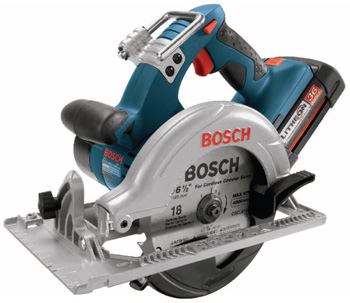
ONCE UPON A TIME, POWER TOOLS came with a cord and life was good. Then came cordless, and life got better. Today, as more manufacturers adopt and perfect lithium-ion battery technology, tool users can be downright giddy at the prospects.
The lithium-ion battery is perhaps the biggest development in cordless tools since, well, the cordless tool. It certainly is the most significant in the last 15 years, says Mike Sherriff, a senior product manager for professional cordless tools at Anderson, S.C.–based TTI North America, manufacturer of the RIDGID brand of power tools. And tool makers say the development of the technology has resulted in ancillary benefits that end users are sure to notice.
“It has the ability to deliver more voltage in a smaller package,” says Shane Moll, vice president of marketing for tools and equipment at Milwaukee Electric Tool Co. in Brookfield, Wis.
“The Li-ion technology uses a special molecule structure that allows current to flow three-dimensionally, instead of through two-dimensional layers in the cell,” Milwaukee’s literature explains. This results in the ability to run power-hungry tools, such as a hammer-drill or a circular saw, the company says.
But lithium does not mean more power in the general sense. It offers a more efficient use of power, which results in a tool that is lighter in weight and runs longer between charges. “Lithium-ion provides an ergonomic benefit as the batteries offer a better power-to-weight ratio compared to other battery technologies,” Baltimore-based DeWalt Industrial Tool Co. says on its Web site.
For example, in order to increase the power of a tool using, say, a nickel-cadmium (NiCad) battery—which was the dominant player until now—the battery had to get bigger and the tool got heavier. Lithium-ion batteries do not have such limitations.
What lithium does mean, however, is more money. Some manufacturers say a lithium-ion tool will cost about twice as much as a comparable NiCad or a nickel-metal hydride (Ni-MH) tool, while others say the increase is not that significant. “In the retail environment, there is a minor cost increase,” says Moll, “but that is slowly going away. You are seeing a lot of the price points come down.”
Though manufacturers agree that NiCad technology will still be viable, most agree that lithium-ion usage will only increase. “Over the next five years, I see NiCad usage dropping off,” says Sherriff. “It’s like the cassette [after the introduction of CDs].”
But this raises another issue: What do you do with your old NiCad tools? Some are being recycled, but not enough of them—at least according to a recent builder survey by the Durham, N.C.–based nonprofit Rechargeable Battery Recycling Corp. (RBRC).
“This survey showed that although many [contractors]—44 percent—are currently recycling the rechargeable batteries in their cordless power tools, close to 30 percent are not actively recycling them, although they know that they are recyclable,” says Linda Gabor, the group’s manager of marketing and media relations.
In 2001, the group expanded its Call2Recycle program to include the collection and recycling of all small rechargeable batteries, adding Ni-MH, lithium-ion, and NiCad. “However, as more end users make the leap to lithium-ion–powered products, they also need to make the environmental commitment to recycle the rechargeable batteries in their cordless power tools that are no longer going to be used.”
At the moment, builders can bring their batteries to such retailers as The Home Depot, Lowe’s, and Sears for recycling, but participation is minimal.
Few builders have the infrastructure in place to encourage battery recycling within their companies. “Only 35 percent of builders currently have a recycling program at their company, and only 16 percent of those builders’ programs include recycling batteries,” Gabor says. “This finding presents an opportunity for RBRC to further educate builders on their environmental responsibility, and in some states, their legal obligation.”
Sherriff says lithium-ion batteries should be recycled at the end of their lives, but he adds that it is a “greener” battery than NiCad because it does not have any heavy metals. Most, if not all, major tool manufacturers are members of RBRC and support recycling programs.
For more product information, visit ebuild, Hanley Wood’s interactive product catalog, at www.builderonline.com or www.ebuild.com.