Located on 2,000 rugged acres, this Montana retreat may not be e…
Ranch Retreat
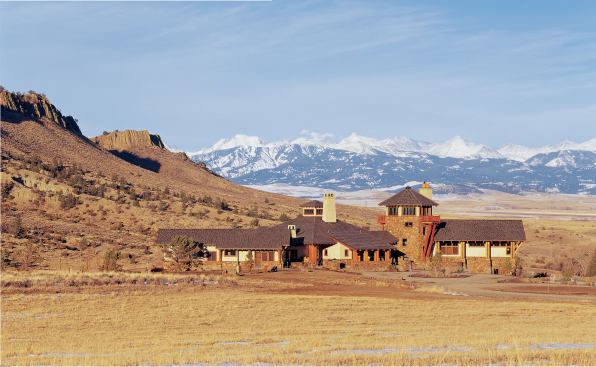
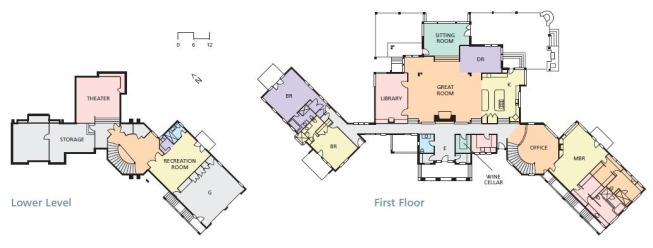
This Montana ranch house may look a bit too roomy to be a part-time residence for two, but that is only part of its job. Because the husband is a corporate CEO, extended stays require not only a well-equipped office but also the ability to host large meetings. And if you invite guests to this beautiful but relatively remote spot—an hour outside of Bozeman—you’d better be able to put them up in style. “It is basically an entertainment facility,” says project architect Shane Ruegamer, “but small enough to serve their needs as homeowners.”
Located on 2,000 acres of land held under conservation easement for grazing and hay production, the house copes smartly in a sometimes harsh environment. Oriented toward mountain views to the east, the building turns its back to winter’s fierce west winds. A separate structure houses a back-up generator that feeds essential circuits during power outages, but whose primary purpose is to pump water from an irrigation pond to wet the house and its surrounding vegetation should wildfire threaten.
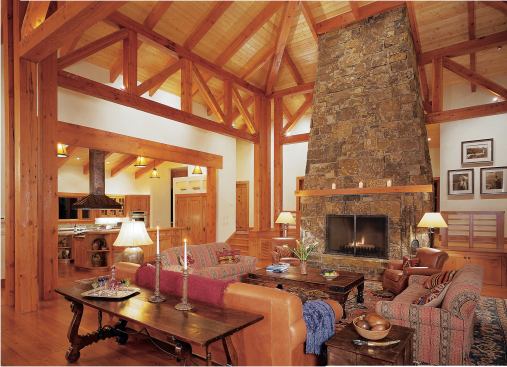
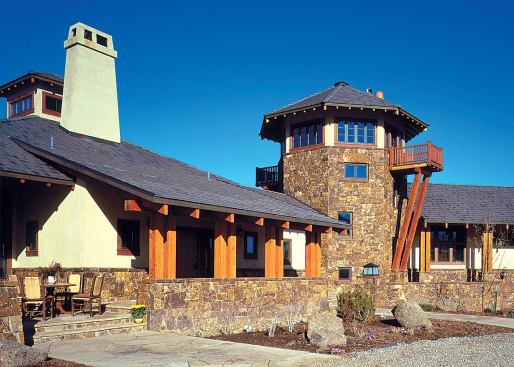
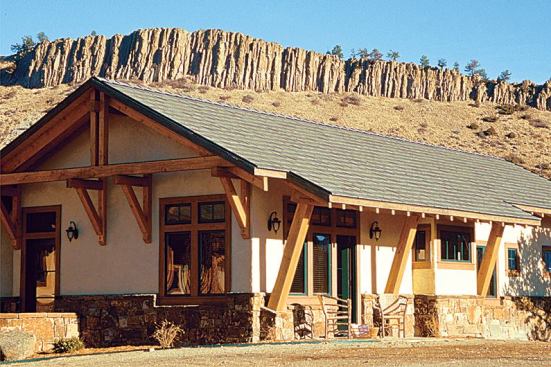
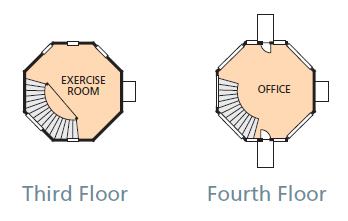
The main building takes its cues from classic Western ranch and lodge architecture, and from its rocky site. Its base and tower of Montana sandstone masonry reinforce the impression of rootedness in the landscape. A massive roof structure, framed with recycled Douglas fir timbers, matches the scale of the building and offers a solid feeling of shelter. And while the house reflects the rugged Montana landscape, it also showcases the community of artisans that thrives in the area. Hand-forged iron stair rails, light fixtures hammered out by a blacksmith, a rich three-coat plaster job, and custom cherry casework are all the work of talented local hands.
Project Credits: Builder: Arlee Green Construction, Bozeman, Mont.; Architect: Leavengood Architects, Seattle; Living space: 9,500 square feet; Site: 2,000 acres; Construction cost: Withheld; Photographer: Lara Swimmer.
Resources: Bathroom plumbing fittings: Jado, Newport Brass, Phylrich; Bathroom plumbing fixtures: Kohler; Dishwasher: Bosch; Hardware: Sun Valley Bronze; Kitchen plumbing fittings/fixtures: Kohler, and Newport Brass; Lighting fixtures: Halo, Iris, Lightolier, Sea Gull; Oven: Thermador; Patio doors/windows: Kolbe & Kolbe; Range: Viking Refrigerator: Sub-Zero.
Island Earth
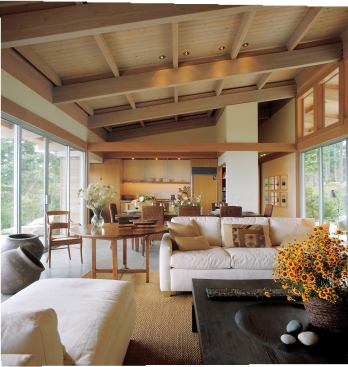
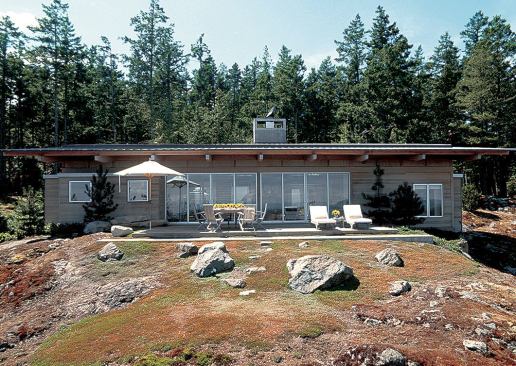
For city dwellers and suburbanites, hemmed in by neighbors and roads, a vacation home offers the opportunity to develop a deeper connection with a patch of earth.The owners of this house, in Washington state’s San Juan Islands, began the process earlier than most. As weekend tent campers, they had enjoyed the ocean views from this property for years before ever deciding to build there. Architect George Suyama conducted a thorough site analysis, but in the end determined that the best place to build was on the rocky promontory that had been their campsite all along.
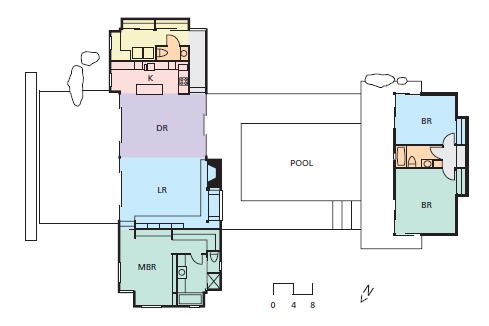
The ground-hugging compound that Suyama designed reflects the clients’ intimate relationship with their site. “It doesn’t have a formal entry,” Suyama says. To enter, “You cross rocks that were uncovered during construction.”The main house and a smaller guesthouse face each other across an open courtyard and pool, planted on concrete floors continuous with the pool deck, much like tents on a stepped platform.
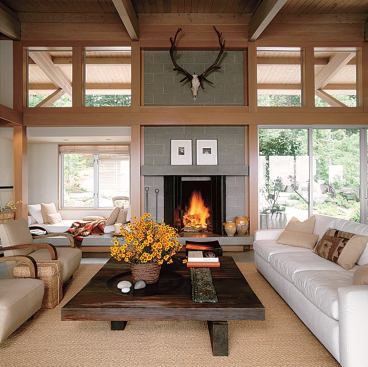
The buildings’ deep overhangs, simple, open interiors, and exposed structural members reflect the owners’ ambivalence about striking their tent and moving indoors. Straightforward, low-maintenance materials—cedar siding, standing seam metal roofs, a concrete block chimney—express the casual intent of the buildings, and banks of sliding doors convert both structures for indoor/outdoor use. The result, like a fine pair of hiking boots, offers comfort while still transmitting the feel of the earth. -B.D.S.
Project Credits: Builder: Paulson Construction, Friday Harbor, Wash.; Architect: Suyama Peterson Deguchi Architects, Seattle; Living space: 2,600 square feet; Site: 20 acres; Construction cost: Withheld; Photographer: Claudio Santini.
Resources: Bathroom plumbing fittings/fixtures: Kohler, Porcher, Vola; Brick/masonry and fireplace: Buckley Rumford; Doors: Kawneer; Hardware: Corbin Russwin; Interior doors: Northstar Woodworks; Kitchen plumbing fixtures: Arwa; Lighting fixtures: Halo, Stonco; Oven: DCS; Paints/stains: Olympic, and Sherwin-Williams; Refrigerator: Sub-Zero; Structural lumber: Georgia Pacific; Windows: Milgard.
Camp Site
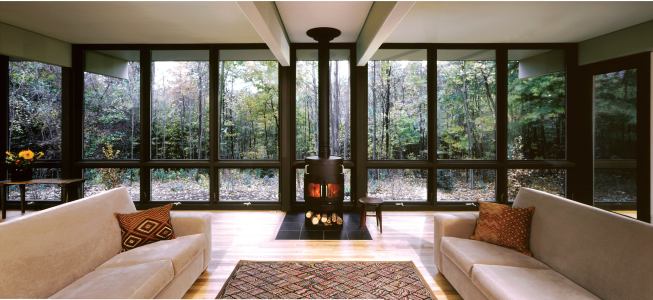
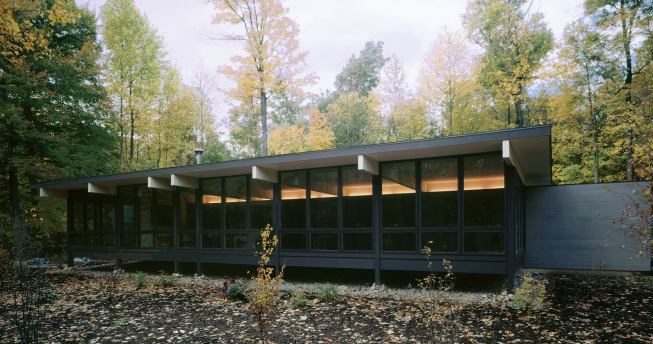
The site of this northern Michigan vacation home was once part of an old Boy Scout camp, and one can imagine the perplexity among the scouts had they stumbled into this clearing on one of their hikes. But while it might upset the rustic stereotype of a woodland retreat, this stealthy slab of Modernism provides a remarkably direct experience of its natural setting. As refined in its plan and details as any urban loft, it is as close and open to the surrounding trees as a Boy Scout tent.
In the clients’ program, says architect Larry Kearns, “The most important things were privacy and proximity to the natural vegetation all around.” Kearns developed the site and house as a series of experiences that heighten the sense of seclusion. The parking area’s distance from the house reinforces the feeling of leaving the city life behind. A winding gravel footpath leads through dense second-growth forest and into the sparsely landscaped clearing, were one encounters the building, with its low, orderly, and mysteriously quiet form. Topped with a continuous band of clerestory windows and a flat roof, the dark-stained cement board entry facade presents a solid wall broken only by the front door. The house, Kearns says, “is not there to necessarily be inviting to neighbors in the traditional sense.”
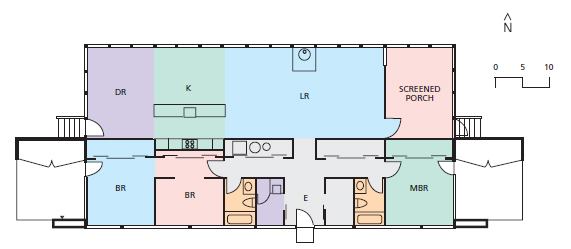
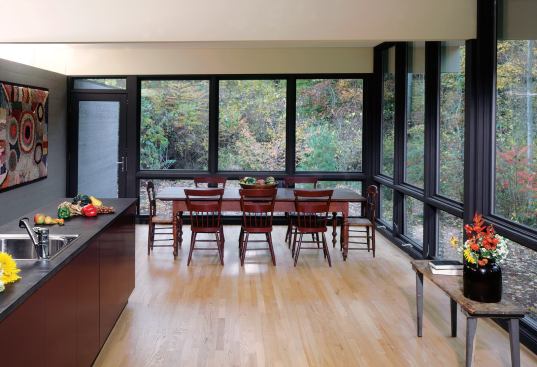
Inside, the building is divided longitudinally by a cedar-boarded “thick wall,” containing closets and utilities, that separates the entry hall and bedrooms from a large public area. In a house designed around a sequence of passages—from parking to woods to clearing to house—the thick wall serves as gateway to the ultimate reward: a great room, walled in glass on three sides. Here, in its utter simplicity and openness, the structure seems little more than a very elegant roof propped up amid the trees. Precisely, says Kearns. “It’s about keeping a very modest preserve in the natural setting.”
Project Credits: Builder: C&S Hemminger Construction, Buchanan, Mich.; Architect: Wheeler Kearns Architects, Chicago; Living space: 2,100 square feet; Site: .5-acre lot on a shared 360-acre property; Construction cost: Withheld; Photographer: William Kildow.
Resources: Entry doors/windows: Hurd; Fireplace: Rais; Hardware: Schlage; Lighting fixtures: Nulite; Refrigerator: Sub-Zero; Sheathing: Hardipanel; Stains: Cabot.