Backyard Ecology

Rain gardens are as eye-pleasing as they are practical.

6 MIN READ

The simplest rule of thumb is that a rain garden’s surface should be about 30 percent of the roof area that will drain into the garden (a little less for sandy soils). It should sit a minimum of 10 feet away from the house foundation, avoiding the septic field, and along a 1 percent downslope from house to garden. Typically a rain garden holds several inches of water during a storm, so it needs to be about 3 inches lower than the rim of the lawn. Large gardens can go deeper toward the center, but the bottom must be level.

Landscape designer Rebecca Shilt of RiverMaid Designs has installed roughly 100 rain gardens in Grand Rapids, Mich. A perk test is de rigueur there because of the clay soil. To keep the rain garden from becoming a breeding ground for insects, standing water needs to drain in a day. She often digs down as much as 6 feet, working in equal parts sand, compost, and topsoil. For more balanced soils, a 6-inch-deep improvement does the trick. “I have been called in to fix a lot of rain gardens,” Shilt says. “People end up creating a swamp.” Because of the weeding and mulching required until the plants fill out—it takes about three years—smaller is better. “I wouldn’t go over 20 feet by 40 feet, and might do a couple of those for a large custom home,” she says.

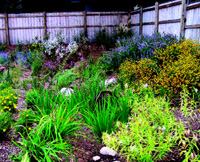
Rain gardens, like these by RiverMaid Designs, are often planted with herbaceous shrubs that can simply be mowed in the fall. Many of the plants that grow well in rain gardens also attract birds and butterflies. Photo: Patricia Pennell A Living System. In parts of the Southwest, builders are required to grade for a similar concept called micro basins that conserve runoff from residential landscapes. Jo Miller, water conservation program manager for Glendale, Ariz., says that given the region’s sandy soils, the issue is not so much achieving proper drainage as selecting plants that are adaptable to different amounts of rain. “Here it’s either feast or famine,” Miller says. “We use a lot of natives and imported plants from other deserts.” Natives are also a wise choice in water-rich regions; they’ve evolved over thousands of years, so they don’t need water or fertilizer. Still, a thorough knowledge of plants is crucial. “You want to make sure a rain garden will have the proper amount of water to support the plant, or you’ll have to irrigate,” English says. “Anything that’s called an emergent aquatic—a plant that grows on the grassy edge of native wetlands, such as Louisiana iris and yellow flag—will grow in standing water in spring, and then be able to tolerate a long dry spell.”

Homeowners often feel helpless to solve big environmental problems, but a raw construction site presents an opportunity. Rather than opting for the desultory large, flat lawn, creating a rain garden is one way clients can practice good ecology at home.—Cheryl Weber is a freelance writer living in Lancaster, Pa.


About the Author

Upcoming Events

  • Happier Homebuyers, Higher Profits: Specifying Fireplaces for Today’s Homes

    Webinar

    Register for Free
  • Sales is a Sport: These Tactics Are the Winning Play

    Webinar

    Register for Free
  • Dispelling Myths and Maximizing Value: Unlock the Potential of Open Web Floor Trusses

    Webinar

    Register for Free
All Events