If you need an attention-getter in the backyard, you can’t do any better than a feature boasting fire and water.
With these elements, you can think big or small. If the family would like something intimate, a cozy fire and water bowl next to the spa will be a perfect fit. For those with a grander vision, you can create a miniature volcano with flames billowing at the top and water spilling down the sides, or a long fire trough in front of a sleek water wall.
Whichever direction you and your client choose to go, you need to set up the system correctly. Consider the following construction guidelines:
Separate the fire and water. Some designers and homeowners want to emulate resort-type features that shoot fire directly out of the water. This is done by bubbling gas up through the water, and introducing a spark of some sort to its surface. Installations of this type may be fine when designed for a resort by a specialty fire consultant. But experts caution against trying to do this in a backyard—particularly when working with remote-controlled systems.
“It goes against code, typically with the electrical and the water,” says Kevin Doud, CEO of manufacturer Grand Effects in Irvine, Calif. “And we feel it’s very prone to maintenance issues, with having the electronics in the water.”
Some have tried using manually lit systems to create the effect. However, it becomes challenging to find submersible fire rings, and you have to consider how to manage the combustion by-products and unburned gas residue that get trapped in the water. “We try to steer [designers] toward having the burner dry. In addition, we encourage housing all the electronics in a container to keep them dry, and hiding the mechanisms so it looks like you’re having fire come out of the water,” Doud says.
Fire feature designers: California Pools, Covina, Calif., and Grand Effects, Mission Viejo, Calif.
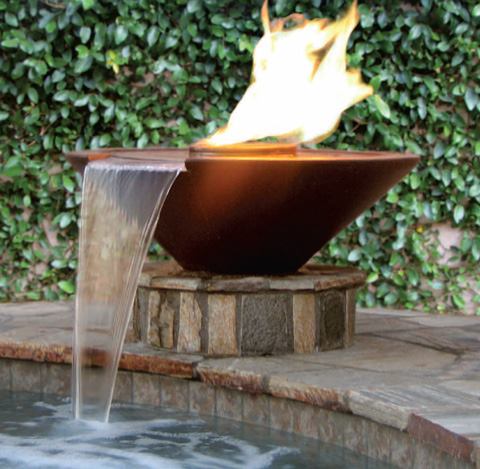
Some companies offer pre-manufactured fire bowls and custom-made fire troughs that do exactly that. In some cases, the water doesn’t even well up in the bowl, but is fed directly via pipe to a sheet fall manifold that spills out of the bowl.
When pool builder Joe Vassallo developed his trademarked WetFlame fire bowl, his first concern was separating the two elements, especially since his containers well up with water before spilling over. The president of Las Vegas-based Paragon Pools creates a spout in the rim of the container that allows the water to pour out long before it reaches the top. Then he places the fire ring at the rim, so it sits above the water exiting at the spout.
For larger features, the same principle of separation applies. For instance, if you want to install a fire trough in front of a water wall, you should create different receptacles for the fire bars and the spill-over from the wall, says Bob Roman, president of Fire by Design, a Henderson, Nev.-based manufacturer of fire and water features.