It’s also a good idea to drill drainage holes in the container that holds the fire hardware. This way, rainwater won’t submerge the remote modules or pilots inside. Roman recommends that troughs be built above deck level—as part of a raised bond beam for example. Building these containers on-ground doesn’t provide a place for proper drainage.
Use the right hardware. When working outdoors, always use stainless steel fire rings and bars. Black steel will rust fairly quickly, causing the outlet holes to clog. Roman estimates that, if you choose the less-expensive black steel, you’ll need to replace it every year or two.
Install the ring or bar with the small holes pointed downward. These openings release gas to create the flame, and if water gets into them, it will impede the ring’s ability to light. Placing it upside down helps keep the area dry.
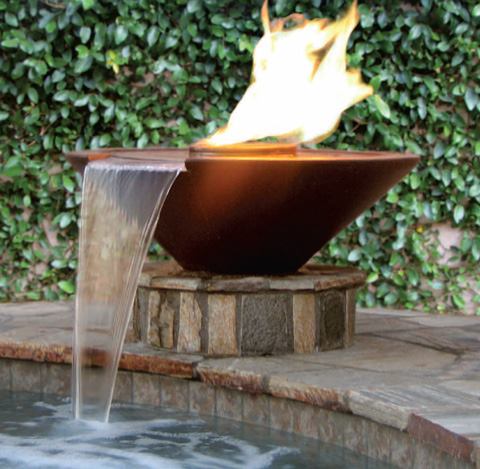
Choose a container that can withstand heat. Vassallo works mostly with concrete bowls, although he’s also had them custom made using stainless steel with a copper coating. To keep the container relatively cool during use, Roman recommends leaving 6 inches between the fire ring or bar and the edge of the pot or trough.
Also keep in mind that the red and yellow flames that are common in backyard applications tend to leave soot behind, which can stain other materials. For this reason, consider darker colors and surfaces around the fire that will be easier to clean.
You’ll need a filler of some type to help conceal the fire ring and other hardware that you place in the container. This way, the installation looks great both day and night. The ideal material is something large enough to leave voids for air to get through. Leave the material clear of the pilot, Doud says. Roman advises against using sand in remote-controlled systems, because it will smother the flame sensor.
The only type of rock known to be completely safe is lava. Other kinds of stone can explode or pop out of the receptacle when it gets hot. Crushed glass can be effective, as long as it’s tempered. To keep it away from the pilot, Doud suggests placing stainless steel mesh over the burner assembly before laying down the glass. The openings should measure about ¼ inch to prevent the glass from falling through. Be warned that, if used in a fire pot, smaller pieces of glass can spill over the spout into the pool water, says Vassallo.
Run the lines for efficiency. When it comes to running the gas lines, think like a plumber. Minimize the run lengths and number of elbows as much as possible, Doud says. Avoid flex gas lines.
You may also need to use manifolds. If you’re creating an especially long trough of fire, you may need to have two bars laid end to end. “The challenge with burner bars over 8 feet long is maintaining a constant flame height from one end to the other,” Roman says. When his clients need their flame to be longer than that, he advises that they use two fire bars of equal length and connect them with a manifold. Like a plumbing manifold, this will ensure equal flow to each bar.
The low-voltage electric lines on remote-controlled systems deserve the same kind of attention when you repeat the fire throughout the yard. If, for instance, you have two or more fire bowls in a line—say, along the top of a wall—you’ll probably want to operate them all at the same time. You can hook them up to the same control button. Run the low-voltage line from one bowl to the other and connect them to the same control, Roman says. If, on the other hand, you have a few fire and water features scattered throughout the yard, the homeowner will probably want to light them at different times. In that case, hook each unit up to its own button on the control pad.