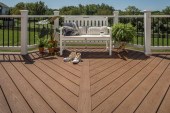
Imagine the delight clients feel when they move into their dream home. There’s the sparkling wall of windows, the handsome stone terrace, and the living spaces oriented to the sun. But look beyond the architecture, and the leftover lot may be less inspiring. Whether it’s a naturalistic setting or a suburban blank slate, custom builders play a role in how well their clients connect with the land outside their new home.
We all have preconceived notions about where things should go—the house here, the patio there, a screen of trees over there. But often we fail to read what landscape architect Carol Franklin calls the “bump and grind” of the land. Alexander Pope put it another way when he counseled, “Consult the genius of the place in all.” Yet this is much easier said than done. So we asked Franklin for a pre- and post-construction primer on how to develop the space outside the drip line in a way that knits together the land, the house, and the larger ecosystem. She lectures on suburban landscapes at the University of Pennsylvania and is a founding principal of Andropogon Associates, a Philadelphia firm known for its ecological sensitivity. Here are some tips for pointing clients in the direction of a natural, satisfying landscape, and one that will save them money in the long run.
As a starting point, keep in mind that an irregular lot makes for a more interesting garden. “Builders and developers should not shy away from oddly shaped lots,” Franklin says. Ideally, a property should follow the lines of vegetative landmarks such as a hedgerow or grove of trees. The same is true with old outbuildings or walls—let the lot configuration respect the existing cultural patterns. Garden-making also begins with placing the house imaginatively on the lot to achieve the best use of outdoor space. A house plopped in the middle of a ½-acre parcel has little usable area on either side, for example; placing it near the edge doubles the available garden space.
It’s not just the lot shape and house placement but the building’s footprint that helps the owners relate to the land. “We’ve got to move away from the standard lump of a house if we want to make beautiful gardens and not yards,” Franklin says. An L- or T-shaped house creates positive garden space, whereas a box or rectangle means outdoor areas must be carved up with fences, walls, and trees. The idea is to let the house extend into the garden and let the garden creep into the house with trellises, terraces, and courtyards.
From there, climate and regional context determine the garden’s character. The question to ask is: What does the garden need to do to make the climate more comfortable? Cold winters call for a sheltered garden, while a hot, dry climate is relieved by shade and moving water that disperses moisture into the air. Humid conditions warrant a garden that captures the breeze. And in the desert, the outdoor “rooms” might be lowered so that they sit in the house’s shade.