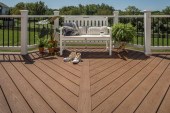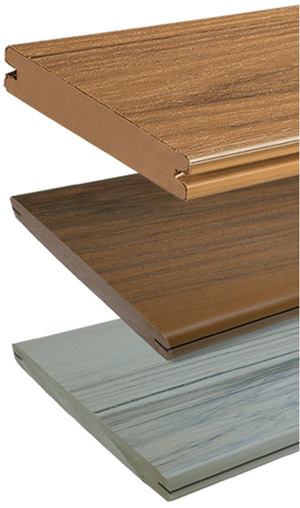
Porch Flooring. While most solid composites mimic square-edged deck boards, one exception is a solid tongue-and-groove porch flooring product called CorrectPorch (formerly Tendura), made by Correct Building Products of Biddeford, Maine. Composed of a polypropylene-hardwood composite like the one used in the company’s decking products, CorrectPorch planks have a 3-inch coverage and are butted like traditional solid-sawn porch flooring. They come pre-drilled 16 inches on center and have a built-in spacer “bead” that creates a gap between boards. The spacer was added in response to thermal expansion problems that affected earlier versions of the product. (A thermal expansion chart can be found at www.correctporch.com/installation.)
For warranty protection, the flooring must have a roof above, be pitched ¼ inch per foot away from the house, and be well-ventilated underneath to prevent heat buildup. It can be left natural or primed and painted.
Hollow Composites. Though generally lighter than their solid counterparts, hollow composites are engineered to be stiffer, which allows for wider on-center spacing—typically 20 inches to 24 inches for residential applications and 16 inches for commercial work.
Hollow decking materials can’t bend the way the solid composites can, however, and usually require wood skirting or proprietary trim pieces to hide the cut ends of boards. As a rule, hollow boards don’t expand and contract as much as solid composites, but most manufacturers nonetheless recommend end-gapping to allow for some thermal expansion. One benefit to these products, though, is that their hollow profile offers a convenient space for running wires and cables for lighting, electrical devices, and speakers.
Some hollow products are tongue-and-groove and are typically installed with a slight gap—about the thickness of a credit card—to allow for expansion. Hollow T&G products may have weep holes or fit loosely enough to allow water to drain through the decking and prevent surface ponding. Even so, sloping the decking surface is also recommended—and sometimes required.
The Wood Look Sells. How realistically a synthetic product mimics wood decking is a key issue for many homeowners. Jack Hanson, owner of Idaho Backyard Living (formerly Woodpile Construction) in Meridian, Idaho, tells his clients, “There’s nothing more beautiful than a wooden deck—for the first six months. Then it’s a maintenance issue from there on out.” Hanson believes composite products hold up better than traditional wood decking, though he concedes that occasionally a composite plank will fade differently from the rest of the batch.
George Drummond, president of Casa Decks of Virginia Beach, Va., says products with deeply embossed wood grains or finishes that emulate the look of tropical hardwoods are most popular with his customers. But finding a deck board that will continue to look good for many years can be tricky. “A lot of the exotic-style deck boards have a sheen on the surface that scratches easily,” he explains. “We install them using drop cloths to protect the surface from our tools, but as soon as the homeowner drags a chair across the deck, there’s a problem.”
Kim Katwijk, owner of Olympia, Wash.-based Deck Builders, set up an experiment in which nearly 600 customers were asked to rate nine different products. His findings mirrored Drummond’s experience: The most popular boards were those with a deep embossed wood grain that approximated the look of a traditional wood plank—products such as CrossTimbers, TAMKO Buildings Products’ EverGrain line, and TimberTech.
Code Approval. With any decking product, there’s more to consider than performance and good looks. As noted by Frank E. Woeste, Ph.D., P.E., professor emeritus of wood science at Virginia Tech, “It appears that less than half of all composite and plastic decking manufacturers have a code report.”
For a plastic or wood-plastic composite decking product to be approved under the International Residential Code (IRC), it must have an International Code Council Evaluation Service (ICC–ES) report indicating that it has passed a series of tests outlined in ICC–ES document AC174, which is based directly on ASTM standard D7032. The standard addresses span, fastener holding ability, bending strength, elasticity, UV and freeze-thaw resistance, fire performance, termite resistance, and the effects of temperature, moisture, and fungal decay.
You can find out if a product is code-listed by asking the manufacturer or checking on the ICC–ES website (www.icc-es.org). There’s also a list of code-approved composite decking products at www.10klakes.org (click on “Composite Decking updated”), the website of a Minnesota chapter of the ICC. Under the 2007 IRC update, which references ASTM D7032, all composite decking manufacturers must include their code listing on their product packaging. As this version of the IRC becomes more widely adopted, determining whether a product is listed should get easier.