Flammability. In areas where wildfires are an issue—Southern California, for instance—additional fire code regulations may apply.
Nearly all composite decking products have fire testing data available from the manufacturer. The most prevalent data is the flame spread index (ASTM E84), a numerical scale from 0 to 200, with 0 being the best possible score. A Class A product has a flame spread index between 0 and 25, Class B between 26 and 75, and Class C between 76 and 200.
Heat Release Rate. Another good measure of flammability is the building product’s heat release rate: The higher the rate, the greater the intensity of fire the product will produce if ignited. “Without copious amounts of flame retardants, construction plastics have heat release rates much higher than wood,” says Vytenis Babrauskas, Ph.D., author of the 2003 Ignition Handbook (Fire Science Publishers, $265). “Though it is possible to add enough flame retardants so that this behavior is controlled, the majority of manufacturers do not do that.”
California Fire Codes. As of Jan. 1, 2008, the California Building Code requires all newly constructed decks to meet a stringent fire performance standard called State Fire Marshal (SFM) standard 12-7A-4. “To be code-approved, the evidence of flaming or glowing must stop and the structure must still be intact after 40 minutes with the burner off,” says Stephen Quarles, a scientist at the University of California, Berkeley. “If the product has a Class C flame spread, then the walls must be covered with noncombustible materials, such as fiber cement or traditional three-coat stucco.”
Manufacturers must submit test data to the California State Fire Marshal to be eligible for code approval. You can find a list of products that pass 12-7A-4 at www.jlconline.com/firetested. If a product you want to use isn’t listed, you must present all of the manufacturer’s fire performance documentation to the authority with jurisdiction for approval.—Reid Shalvoy is a freelance writer based in Burlington, Vt. This article first appeared in THE JOURNAL OF LIGHT CONSTRUCTION.
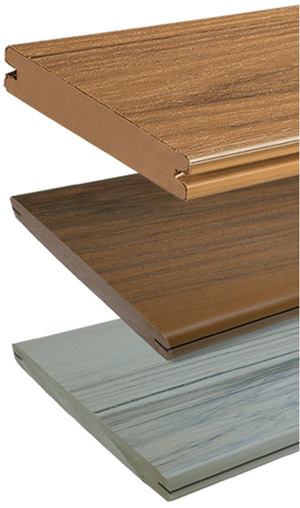
Product Options Correct Building Products. According to its maker, CorrectDeck CX’s blend of 60 percent recovered hardwood fiber and 40 percent polypropylene (part reclaimed) gives the material unusual rigidity and extra resistance to fading, staining, and water absorption. CorrectDeck has a wood-grain texture and comes in six shades. 877.332.5877. www.correctdeck.com.
GAF–ELK Corp. Hollow planks make GAF–ELK’s CrossTimbers decking 30 percent lighter than solid composites. Constructed of polypropylene and nonwood organic material, the decking can be pre-drilled and screwed or installed with hidden clips that lock into the grooved sides. The fire-resistant version of the Professional decking line meets California fire code requirements. 866.322.7452. www.gaf.com.
Fiber Composites. The polyethylene-wood composite used for Fiberon Professional decking contains 80 percent recycled and reclaimed materials. The product comes in several colors and wood tones, with an embossed wood grain on both sides and a 5/4 x 6 profile. Only one fastener is needed at each joist—a feature that reportedly speeds installation. 800.573.8841. www.fiberondecking.com.
LDI Composites Co. LDI’s GeoDeck is a hollow composite made from partly recycled polyethylene and a combination of wood fiber and minerals that is said to reduce fading. It comes in three profiles: 5/4 x 6 T&G (for covered areas), 5/4 x 6 square-edge, and 2×8 heavy-duty. 877.804.0137. www.geodeck.com.
Advanced Environmental Recycling Technologies. Made from 90 percent recycled material, A.E.R.T.’s MoistureShield meets LEED standards for residential decking. It comes in 5/4 x 6 and 2×6 sizes with a ribbed bottom for extra rigidity and ventilation over joists, and is sold in seven colors with an embossed wood-grain finish. Typical installation is with stainless steel trim-head screws—two at each end and one or two at each joist. 866.729.2378. www.moistureshield.com.